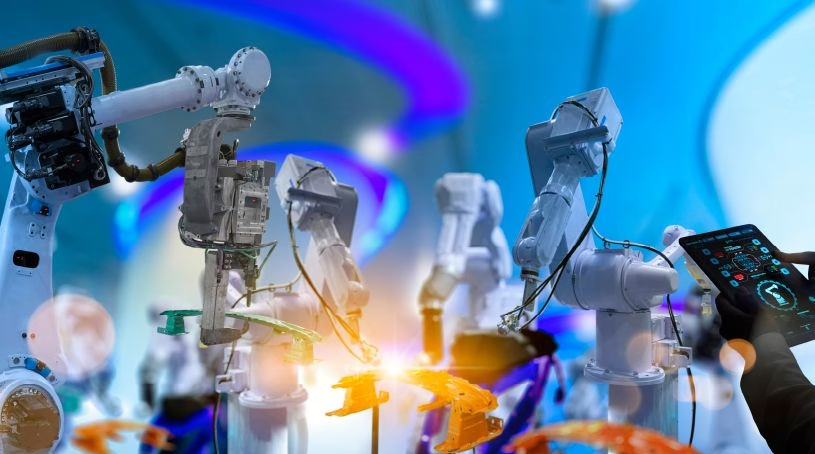

What Are Cobots and Why Are They Game-Changers?
Cobots — collaborative robots — are designed to work directly with humans. Unlike traditional industrial robots that require fencing, cobots operate safely beside workers. Equipped with force-limiting sensors, they pause or stop when encountering unexpected contact. This makes them ideal for small and medium-sized enterprises (SMEs) that want automation without large-scale restructuring. In my engineering projects, cobots often serve as the first automation tool due to their user-friendliness and low risk.
The Evolution of Cobots: From Concept to Core Technology
Cobots were first conceptualized in the 1990s by two professors at Northwestern University. Commercial models arrived about a decade later. By 2023, cobots accounted for 11% of all new industrial robot installations. With annual sales approaching $3 billion and over 30% projected growth, cobots have shifted from niche to necessity. In my view, this rise is driven by their rapid return on investment and adaptability in real-world environments.
Cobots vs Traditional Robots: What Really Sets Them Apart
Traditional robots are built for speed, precision, and power — but they come with a hefty cost and require expert programming. Cobots, on the other hand, are designed for simplicity and flexibility. Many use touchscreen interfaces or teach-by-demonstration methods, where operators manually guide the robot through a task. This reduces the need for costly programming resources. In practice, cobots can be deployed in hours, not weeks, minimizing production downtime.
How Cobots Are Used Across Industries
Cobots are transforming workflows across multiple sectors. In manufacturing, they handle assembly, gluing, screwing, painting, and visual inspections. In logistics, they pack products, palletize boxes, and manage repetitive material handling tasks. I’ve personally overseen deployments in welding and plastics, where cobots reduce worker exposure to dangerous heat and fumes. Their range of end-of-arm tools makes them suitable for nearly any task involving repetition or precision.
Top Cobot Manufacturers to Know
The leading players include Universal Robots (Denmark), ABB (Switzerland), Fanuc (Japan), and KUKA (Germany). Each has developed specific strengths — from intuitive programming to high payload capacity. Startups and regional players are also entering the field, offering more affordable or specialized solutions. My recommendation: assess integration options, post-sale support, and application-specific accessories when choosing a brand.
Do Cobots Threaten Human Jobs?
Cobots increase productivity and reduce errors, but they also stir fears of job loss. In reality, they shift the nature of work. By taking over the 4 Ds — dirty, dangerous, dull, and difficult tasks — cobots allow human workers to focus on quality control, creative problem-solving, and technical oversight. In my experience, successful companies use cobots to upskill their workforce, not replace it.
Conclusion: Collaboration Is the Future of Automation
Cobots are no longer futuristic gadgets — they are essential automation tools for modern industry. Their small footprint, fast setup, and safety features allow companies of all sizes to innovate without overhauling their operations. As a systems engineer, I believe cobots represent the most accessible path to smart manufacturing. Companies that adopt them early will lead in productivity, safety, and workforce satisfaction.