 6G Controls - Leading Supplier of New & Original PLC 、DCS Parts and Automation Controller


Product Overview
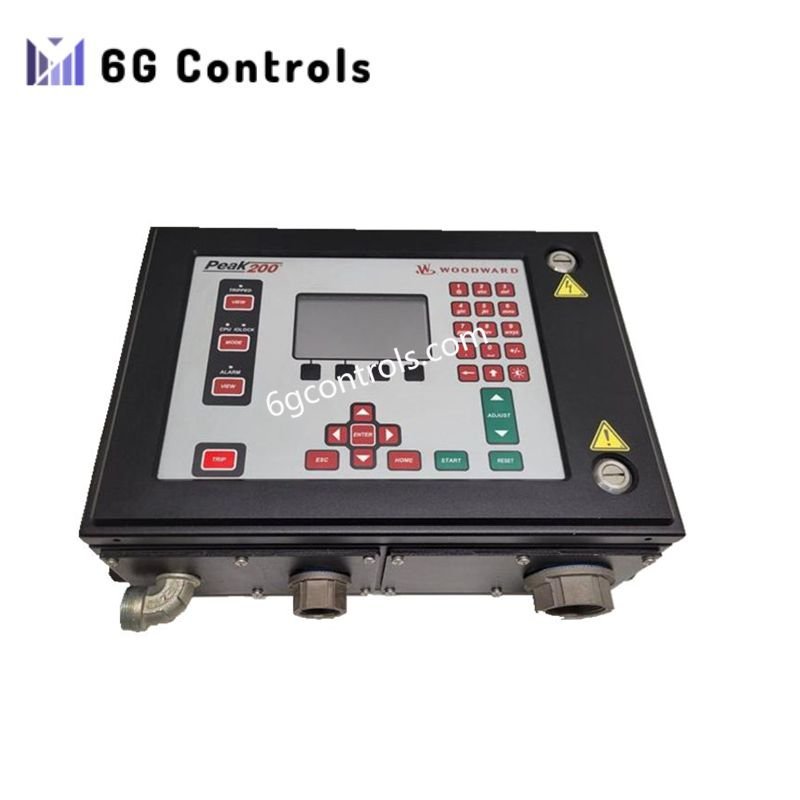
The 8200-1501 is a compact digital steam turbine controller from Woodward, developed within the PEAK200 platform to manage small industrial steam turbines and turbine-driven HVAC systems.
It merges turbine-grade speed and load regulation with configurable multi-loop process control, allowing a single controller to govern both mechanical turbine operation and auxiliary thermal processes.
Designed for single-valve or single valve-rack turbines, this controller delivers stable operation across varying load conditions while maintaining protection functions required for continuous industrial service.
Controller Architecture and Functional Scope
Built on Woodward’s long-established digital turbine control technology, the 8200-1501 integrates turbine logic, actuator management, and process control into one enclosure.
Key functional domains include turbine speed control, load sharing, overspeed supervision, and optional HVAC-oriented PID loops for temperature, pressure, or flow coordination.
Certain firmware variants extend capability into cascade control schemes commonly used in boiler, chiller, or airflow systems.
Control and Protection Functions
The 8200-1501 provides deterministic digital control suitable for small steam turbines operating in island, parallel, or mechanical-drive modes.
Core control functions include:
- Isochronous and droop-based speed regulation
- Automatic and manual load control with smooth mode transitions
- Integrated overspeed monitoring with test and trip logic
- Configurable critical-speed avoidance bands across the operating range
- Actuator command support for electric or pneumatic valve mechanisms
For HVAC-oriented installations, the controller supports dual independent PID loops and cascade PID structures for thermal system optimization.
Electrical and Environmental Specifications
The 8200-1501 is engineered for industrial panels and field-mounted enclosures where environmental robustness is required.
Key specifications include:
- Power input: 24 VDC (industrial low-voltage class)
- Operating temperature range: –20 °C to +60 °C
- Enclosure rating: NEMA 4X (suitable for harsh or wash-down environments)
- Compliance: CE, UL 61010-1, FCC Part 15 Class A
Input and Output Configuration
I/O capacity supports both turbine instrumentation and auxiliary process signals.
Typical configuration includes:
- Analog inputs: up to 8 channels supporting 4–20 mA, 0–10 VDC, RTD Pt100, and thermocouple J/K/T
- Analog outputs: 4 configurable channels (4–20 mA or 0–10 VDC)
- Digital inputs and outputs: 16 combined points for permissives, alarms, and interlocks
- Dedicated actuator output interfaces for valve or damper positioning
Communication and Integration
The 8200-1501 supports industrial and building-system communication standards for seamless system integration.
Available interfaces include:
- RS-485 with Modbus RTU protocol
- Optional BACnet MS/TP support via firmware configuration
These interfaces allow direct connection to PLCs, DCS platforms, or building management systems without external gateways.
Human–Machine Interface
A built-in graphical HMI enables local operation and diagnostics without additional tools.
HMI features include:
- 5-inch color display
- Real-time visualization of speed, load, and process variables
- Alarm and event display with trend views
- Eight-button keypad for local navigation and parameter adjustment
Mechanical Design
The controller is available in panel-mount or bulkhead-mount formats, allowing flexible installation in turbine skids or HVAC control cabinets.
Its mechanical design supports vibration tolerance typical of turbine environments.
Weight: 11.09 lbs
Typical Application Areas
The 8200-1501 is commonly deployed in:
- Small industrial steam turbines for mechanical drive or power generation
- Single-valve or valve-rack turbine installations
- Turbine-driven HVAC systems integrating boilers, chillers, and airflow control
- Packaged turbine skids requiring local HMI and remote communication
FAQ
Q: Can the 8200-1501 be used without HVAC functions?
A: Yes. The controller can be configured purely for turbine speed and load control, with HVAC PID loops disabled.
Q: Is the overspeed function independent of normal speed control?
A: Yes. Overspeed protection operates as a dedicated safety function and supports testing without turbine disconnection.
Q: What actuator types are supported?
A: Both electric and pneumatic actuators are supported, depending on output configuration and firmware setup.


