6G Controls - Leading Supplier of New & Original PLC 、DCS Parts and Automation Controller


Overview
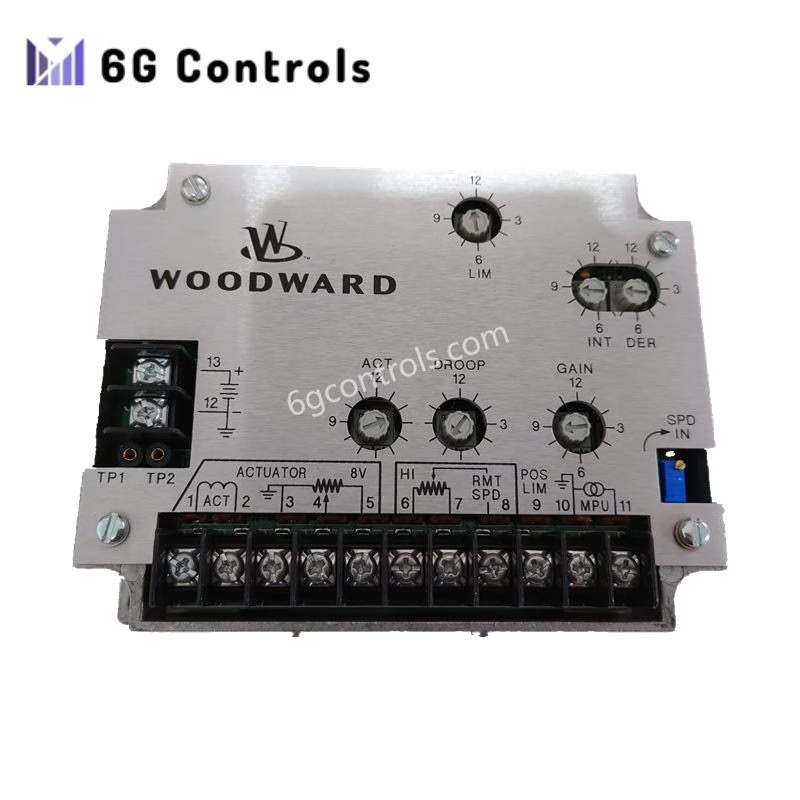
The Woodward 9905-377 reverse-acting governor control module is part of the proven 2301A series of electronic load sharing and speed control systems. It is engineered to regulate turbine or engine speed while maintaining balanced load distribution between multiple generators operating in parallel.
Designed primarily for steam turbine applications, the controller produces a reverse-acting analog output signal. In this configuration, the output current decreases as the commanded speed increases, enabling fail-safe valve closure in the event of signal loss. This behavior is particularly important in steam throttle control systems where safety and stability are critical.
The 9905-377 module integrates speed regulation and generator load sharing into a compact industrial controller, suitable for demanding environments including power plants, marine propulsion systems, and heavy industrial energy facilities.
Technical Specifications
| Parameter | Specification |
|---|---|
| Model | 9905-377 |
| Product Series | Woodward 2301A Electronic Control |
| Control Function | Reverse-Acting Speed Governor with Load Sharing |
| Output Signal | 0–200 mA analog governor output |
| Output Behavior | Current decreases as speed demand increases |
| Power Supply | 20–40 VDC |
| Optional Supply Range | 90–240 VAC |
| Control Architecture | Analog electronic governor module |
| Load Sharing Method | Droop or isochronous load sharing in parallel generator systems |
| Fail-Safe Operation | Control signal loss forces actuator toward closed position |
| Operating Temperature | −40°C to +85°C |
| Enclosure Type | Industrial metal control module |
| Dimensions | 200 × 150 × 80 mm |
| Weight | 4.08 lb |
Key Functional Characteristics
Reverse-Acting Governor Output
The 9905-377 produces a reverse-acting 0–200 mA control signal designed for turbine valve actuators requiring a decreasing current as turbine speed demand rises.
Integrated Load Sharing
When multiple generators operate in parallel, the module coordinates power distribution between units, preventing overload conditions and maintaining stable grid frequency.
Wide Environmental Tolerance
With an operating temperature range from −40°C to +85°C, the controller is suitable for harsh industrial installations, including outdoor turbine packages and offshore facilities.
Fail-Safe Protection
Loss of the control signal drives the system toward valve closure, helping protect turbines from uncontrolled acceleration or overspeed events.
Typical Applications
Steam turbine throttle valve regulation in industrial power plants
Generator load balancing in multi-unit power generation systems
Mechanical drive turbine control in refineries and petrochemical facilities
Marine propulsion turbine governor control
Standalone or parallel generator sets requiring analog load sharing
Compatibility and Integration Notes
The Woodward 9905-377 is designed to interface with Woodward governor actuators and current-driven valve control systems. Proper actuator compatibility must be verified to ensure correct response to the reverse-acting signal output.
For modernization projects, digital successors such as the Woodward 2301D or 2301E controllers may provide additional communication features including diagnostics, digital configuration, and Modbus connectivity.
FAQ
What distinguishes the 9905-377 from other 2301A modules?
The 9905-377 is specifically designed with a reverse-acting analog output. This configuration is commonly used in steam turbine systems where safety logic requires the valve to close when control current is lost.
Can the module be used in generator load sharing systems?
Yes. The unit supports load sharing between generators operating in parallel through droop or isochronous control modes.
What power supply does the controller require?
The standard operating supply is 20–40 VDC, though some installations may support 90–240 VAC depending on system configuration.